Why the Difficult Airway Kills — Oxygenation, Not Intubation
"The central lesson of every airway-disaster analysis — from the ASA Closed Claims to the UK NAP4 project — is that patients do not die because the trachea cannot be intubated; they die because they cannot be oxygenated, and because repeated, forceful attempts at laryngoscopy convert a difficult airway into a 'cannot intubate, cannot oxygenate' catastrophe. The goal is oxygenation, not a tube. Declare failure early, limit attempts, and escalate the plan before hypoxia and trauma make rescue impossible."
Synthesised from NAP4 (4th National Audit Project, RCoA/DAS 2011) & the ASA Difficult Airway Practice Guidelines 2022.Core Principles (NAP4 / ASA 2022 / DAS)
- Oxygenation is the priority — not tube placement. Maintain SpO₂ with bag-mask / supraglottic device / apnoeic oxygenation between attempts.
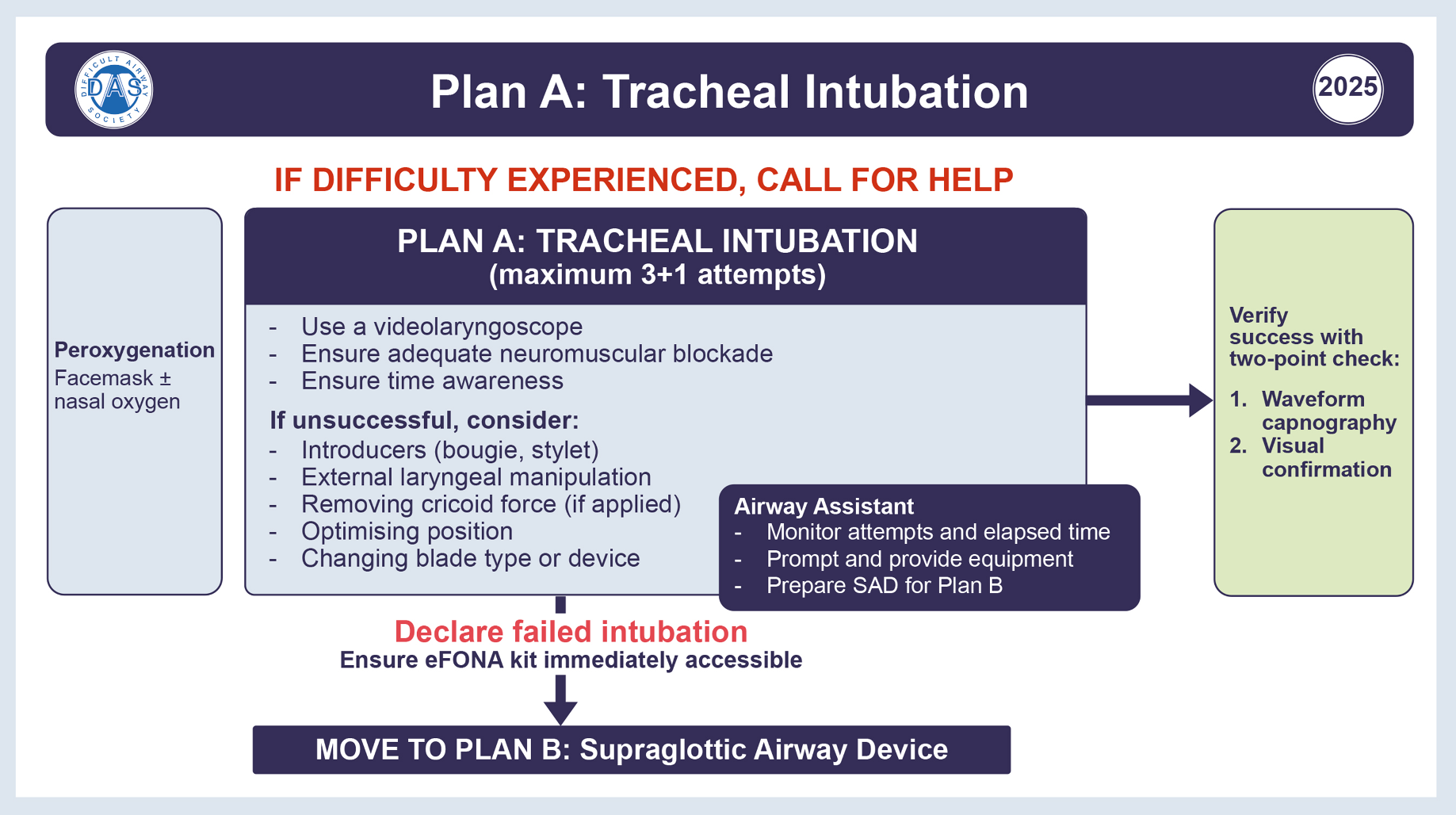
- Limit laryngoscopy attempts — a maximum of 3 + 1 (3 by the primary operator, 1 by a more experienced colleague). Each attempt should change something (operator, device, position, blade).
- Declare failure early and move down the plan — fixation on intubation ("just one more look") is the commonest fatal error.
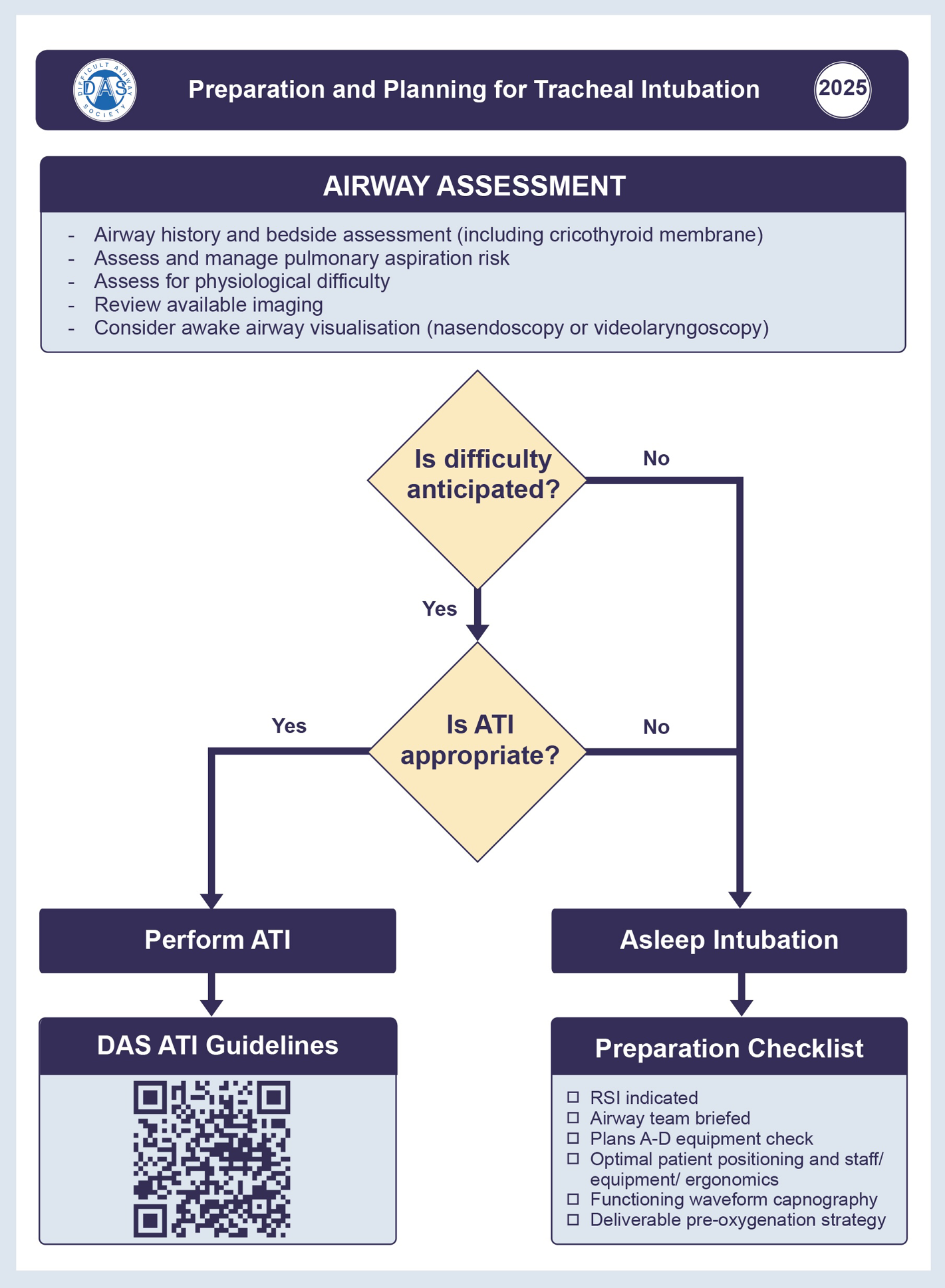
- Plan and verbalise before induction — a shared, spoken airway plan (Plan A→B→C→D) with the team, and the failed-airway equipment open and ready.
- Have a CICO plan for every airway — know, and be ready to perform, front-of-neck access.
AIDAA 2025's biggest change from 2016: it now covers failure of ANY primary technique (SGA, intubation, or face-mask), not just failed intubation — and introduces "Code D" as the hospital airway-emergency call, a non-hierarchical rescue between the three devices, and a clear definition of complete ventilation failure → emergency surgical cricothyroidotomy (detailed in §6). AIDAA 2025
Assessment — Difficult Mask, Laryngoscopy, SGA & FONA
Mask seal (beard) · Obesity/Obstruction · Age >55 · No teeth · Stiff lungs/Snores. Anticipating difficult mask ventilation AND difficult intubation AND difficult FONA together is what should trigger an awake technique rather than induction.
DAS 2025 Unanticipated Difficult Intubation — Sequential Plans
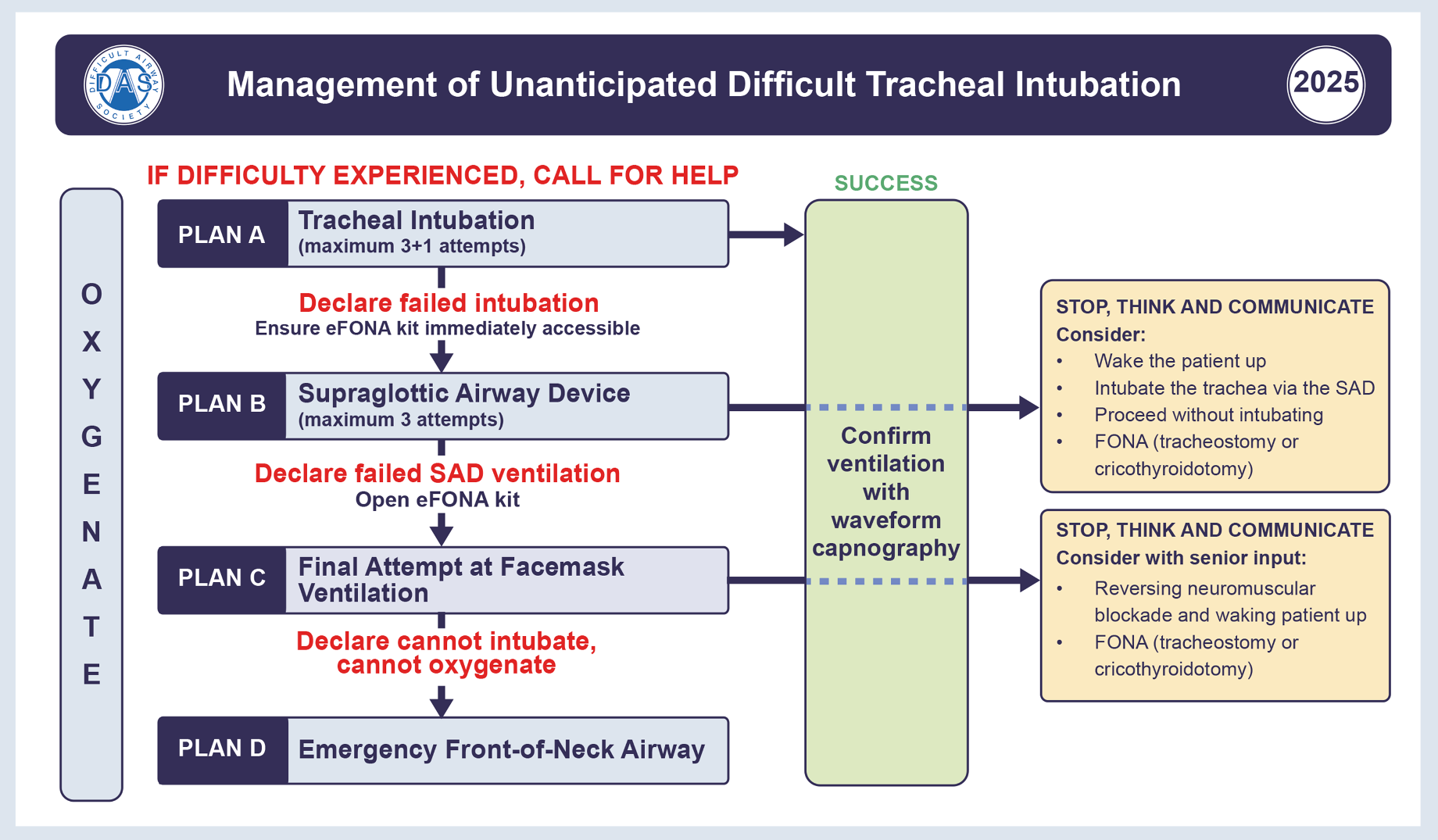
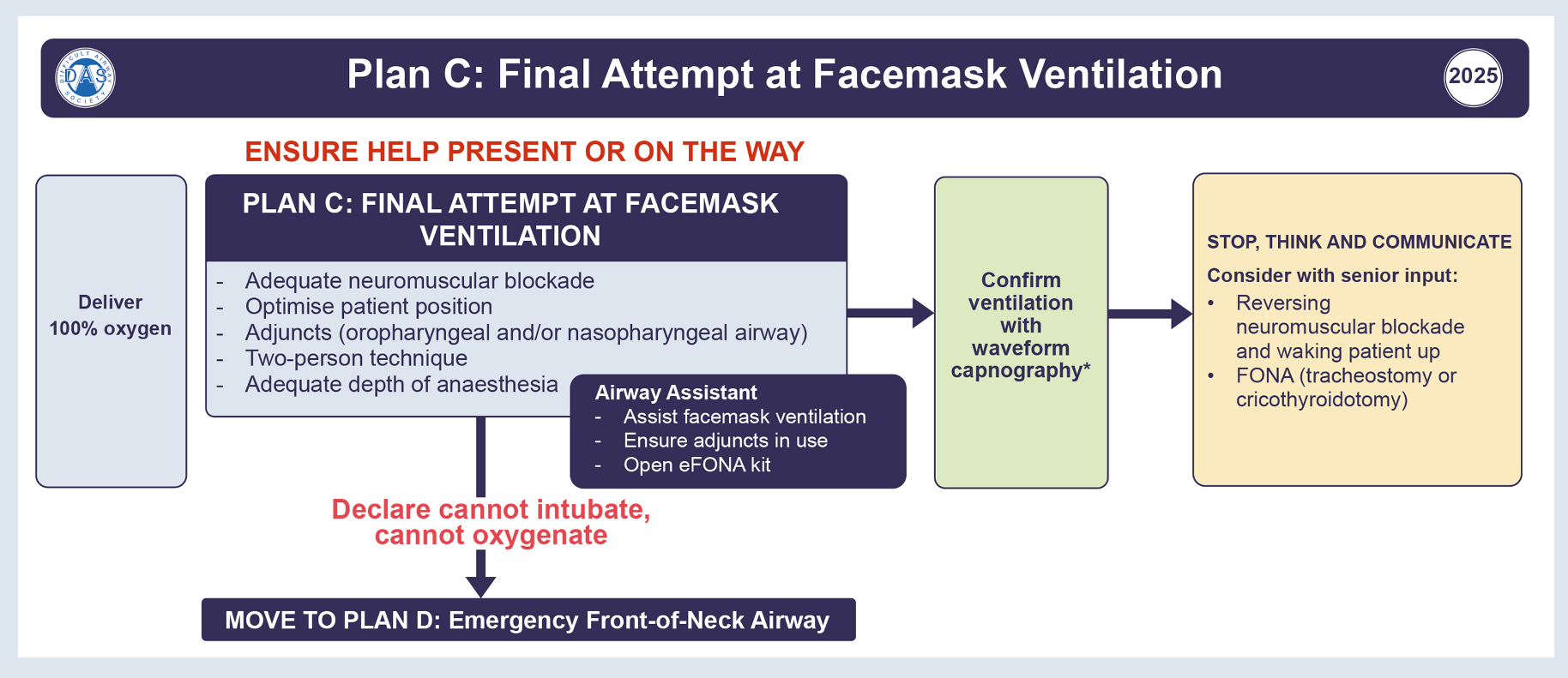
⚠️ Plan D — CICO: "Cannot Intubate, Cannot Oxygenate"
Declare it out loud. Give 100% O₂, ensure full paralysis, and proceed IMMEDIATELY to emergency front-of-neck access (eFONA). Do not delay for further laryngoscopy. This is a surgical airway emergency — minutes matter.
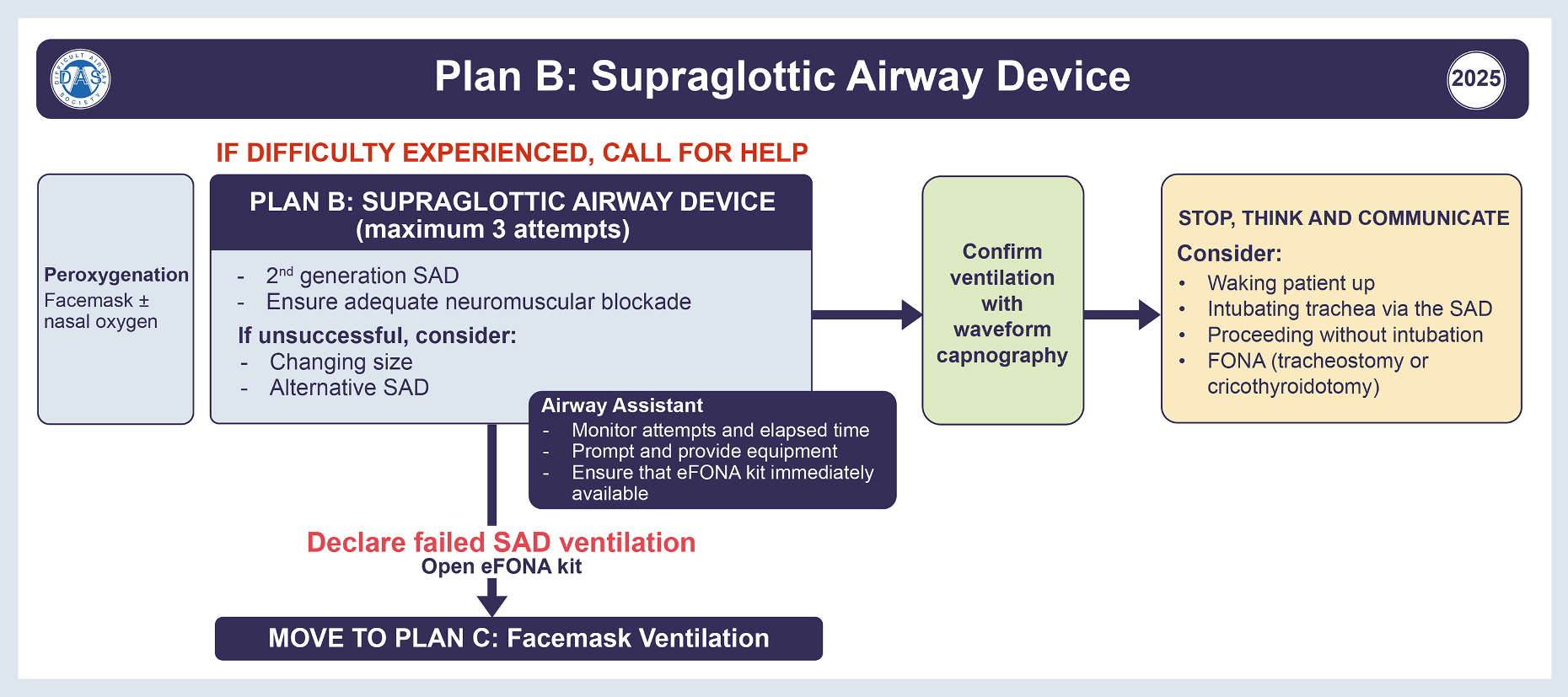
DAS 2025 — Step-by-Step Algorithm Cards
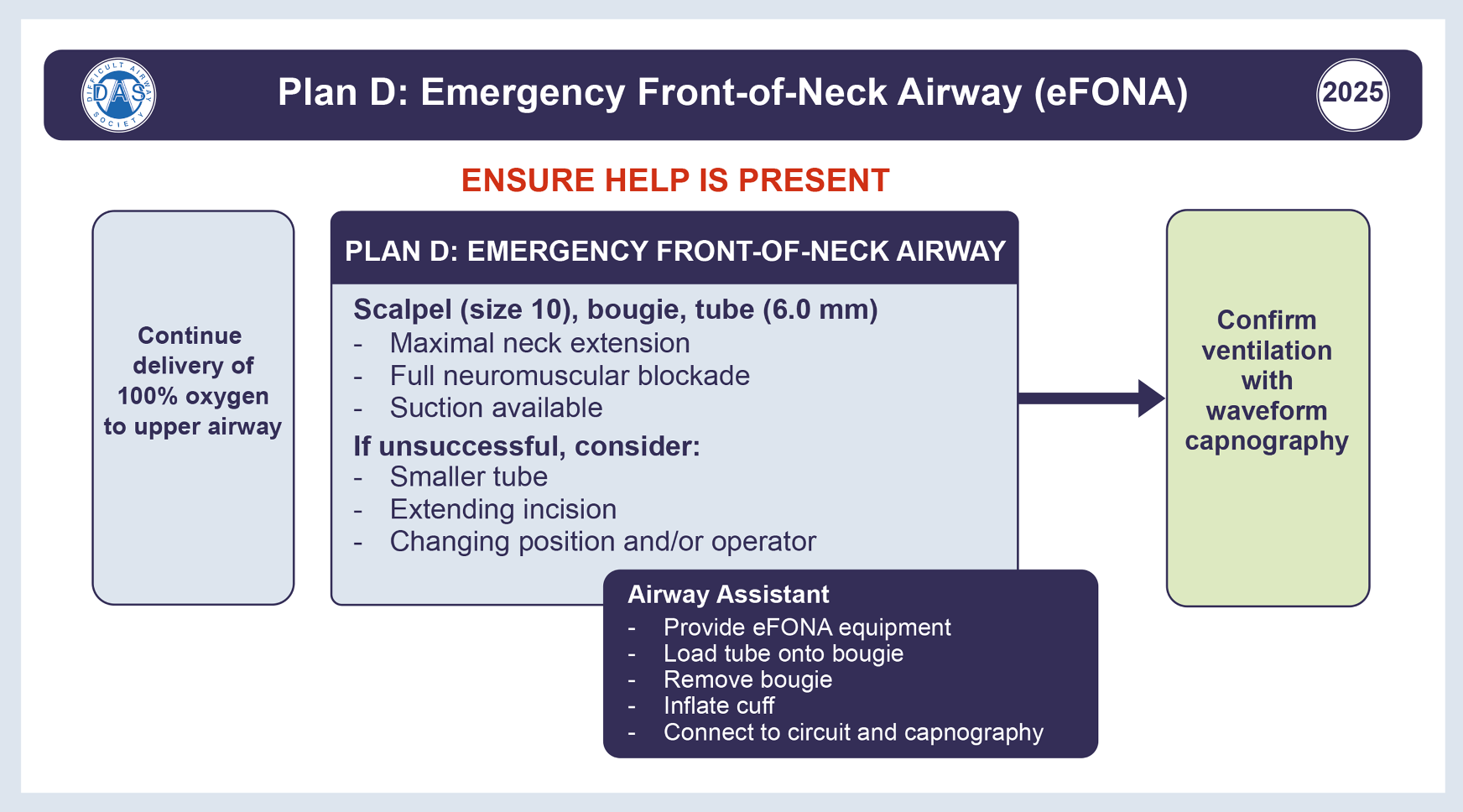
The official DAS 2025 cards for each stage of the pathway. Tap any to view full-screen. Difficult Airway Society 2025, Br J Anaesth.
RSI Drugs & the Airway Trolley
| Drug | Role | Dose | Notes |
|---|---|---|---|
| Ketamine | Induction (shock/bronchospasm) | 1–2 mg/kg IV | Haemodynamically stable; preferred in shock |
| Propofol | Induction (stable) | 1–2.5 mg/kg IV | Causes hypotension — reduce in shock/elderly |
| Etomidate | Induction (haemodynamically neutral) | 0.3 mg/kg IV | Adrenal suppression after single dose (usually accepted in RSI) |
| Rocuronium | Paralysis (RSI) | 1.2 mg/kg IV | Reversible with sugammadex 16 mg/kg; preferred when sux contraindicated |
| Succinylcholine | Paralysis (RSI) | 1.5 mg/kg IV | Avoid in hyperK, burns >24h, crush, denervation, myopathy |
| Sugammadex | Reverse rocuronium (CICO rescue) | 16 mg/kg IV | Restores spontaneous ventilation IF rocuronium used — does NOT guarantee a patent airway |
| Phenylephrine / Noradrenaline | Peri-intubation hypotension | Push-dose / infusion | Resuscitate BEFORE you intubate (avoid peri-intubation arrest) |
Videolaryngoscope · range of blades/tubes · bougie · second-generation SGAs (i-gel sizes) · oral/nasal airways · scalpel (size 10), bougie & size-6.0 cuffed tube for FONA · capnography (mandatory — confirms tube & detects oesophageal placement) · suction. Resuscitate before you intubate: optimise pre-oxygenation, haemodynamics (fluids/pressors) and position first.
The Surgical Airway — Scalpel–Bougie–Tube
🔪 Scalpel Cricothyroidotomy (DAS-recommended technique)
- Identify the cricothyroid membrane (laryngeal handshake; in a "impalpable neck" make a vertical skin incision first and finger-dissect).
- Stab incision through the cricothyroid membrane with a size-10 scalpel; turn the blade 90° (sharp edge caudad).
- Bougie — slide a bougie alongside the scalpel into the trachea (railroad technique).
- Tube — railroad a cuffed size 6.0 tracheal/tracheostomy tube over the bougie; inflate cuff, confirm with capnography, ventilate.
FONA is rare and high-stakes — regular team simulation and a pre-stocked, standardised FONA kit (scalpel, bougie, 6.0 tube) on every airway trolley are the interventions that actually save lives, far more than the choice of technique. Human factors (declaring the emergency, role allocation, avoiding fixation) are the dominant determinant of outcome (NAP4).
All India Difficult Airway Association (AIDAA) 2025
"The All India Difficult Airway Association 2025 Adult guideline provides guidance for the management of an unanticipated difficult airway under general anaesthesia… The most significant difference from the 2016 guidelines is providing guidance for a failed supraglottic airway insertion, tracheal intubation, face mask ventilation, or other strategies commonly used as part of the primary airway plan — not restricting to a failed intubation."
Myatra SN, Shah AP, Ramkumar V et al. AIDAA 2025 Guidelines. Indian J Anaesth 2025;69:1117–1141. (AHA Class of Recommendation / Level of Evidence + Delphi consensus.)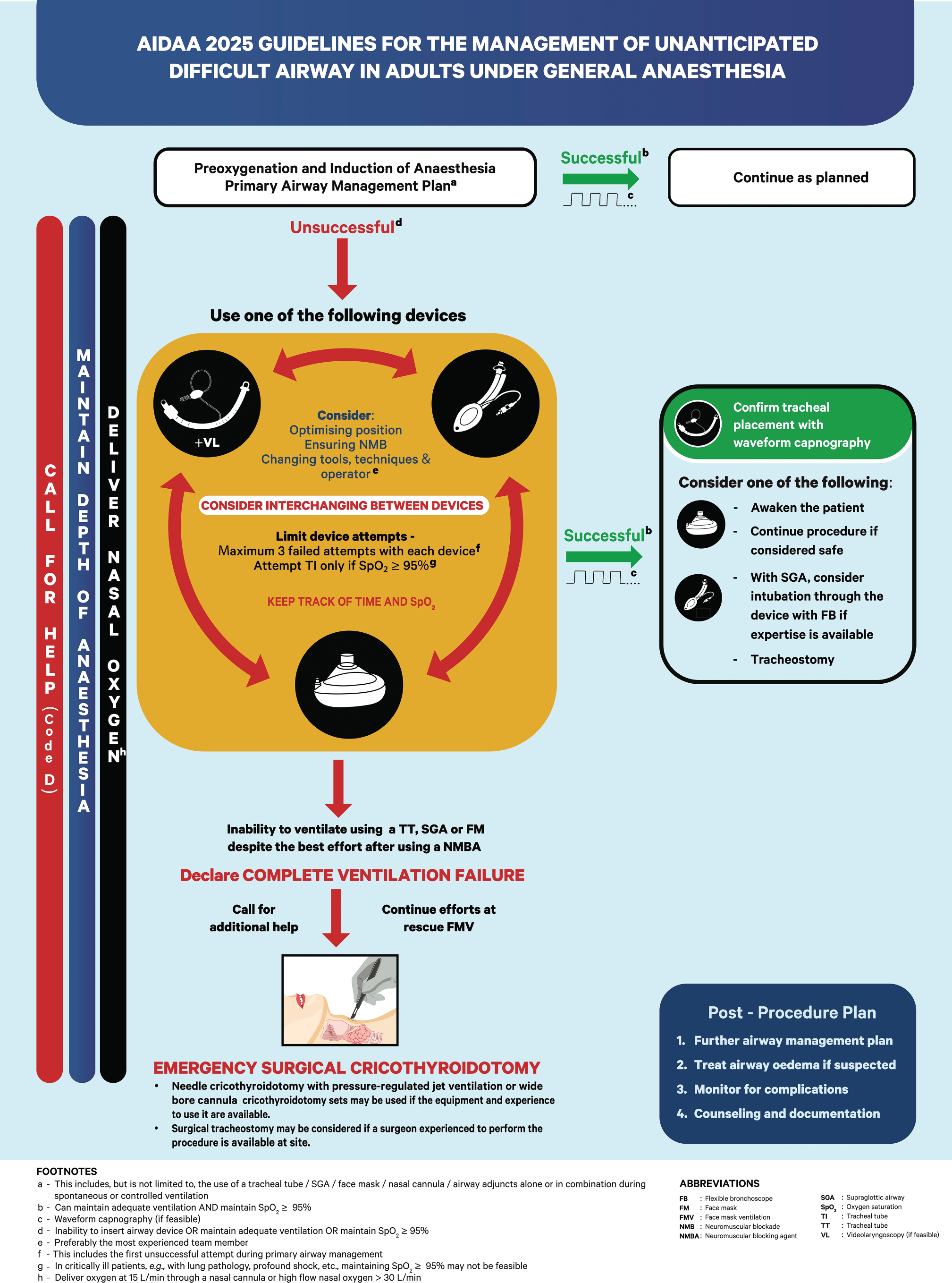
Peri-intubation oxygenation: pre-oxygenation + apnoeic oxygen via nasal cannula (10–15 L/min) or HFNO to extend safe apnoea time.
First-pass success: videolaryngoscopy + adjuncts (stylet, bougie). Confirm tube position with waveform capnography.
⚠️ Complete Ventilation Failure → Emergency Cricothyroidotomy
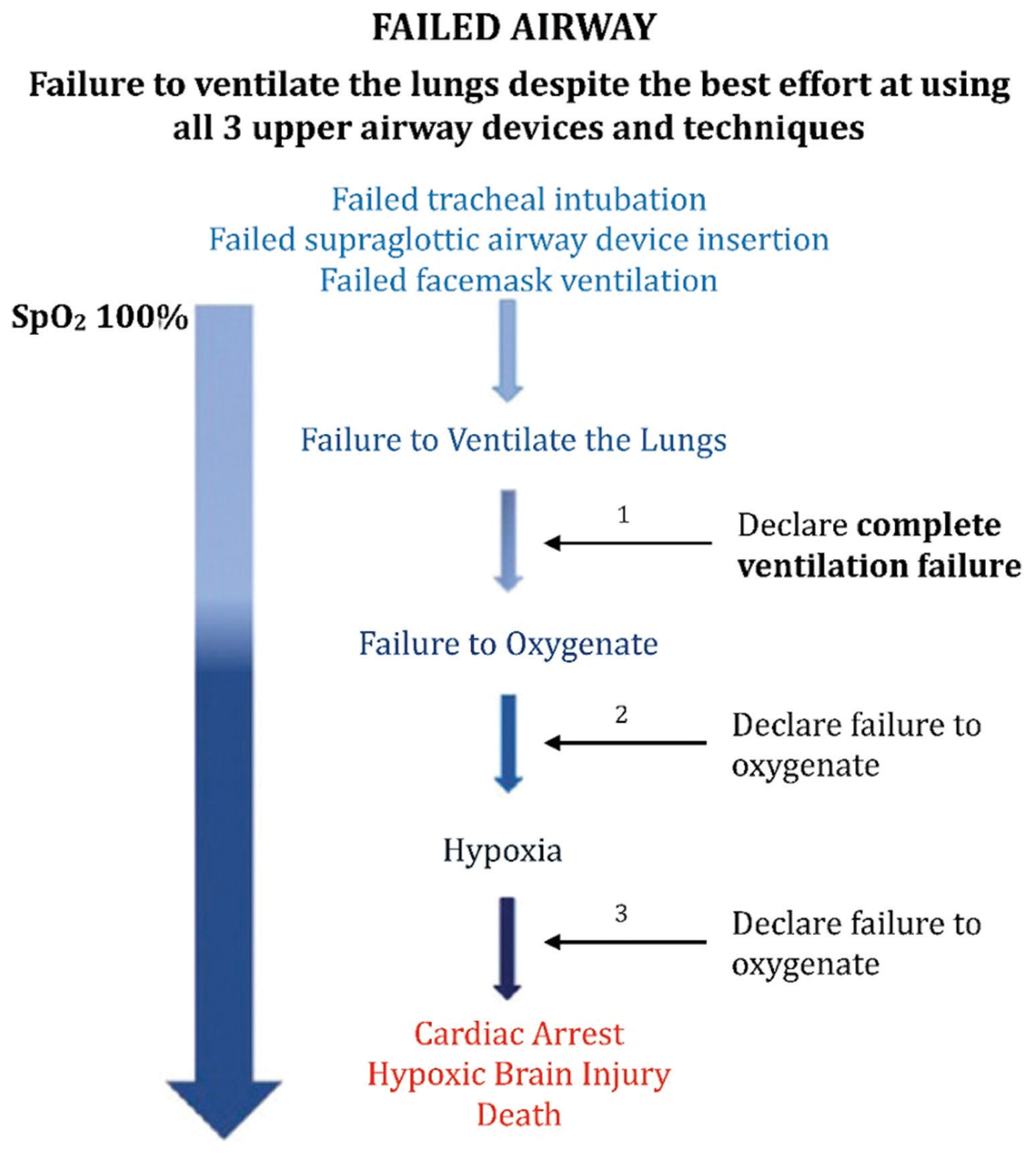
"Complete ventilation failure" — ventilation with the tracheal tube, SGA and face mask have all failed (even if oxygenation is briefly maintained) — is the trigger to perform an emergency cricothyroidotomy, preferably by a surgical approach (scalpel–bougie–tube). Do not delay. Follow with team debriefing, team & patient/family support, and documentation.
Extubation is a planned, reversible, "low-risk vs at-risk" decision. For the at-risk airway: optimise the patient, have re-intubation equipment ready, consider an airway exchange catheter, extubate awake, and keep the failed-airway plan available. Many airway deaths occur at extubation/recovery, not intubation (NAP4).
Common Mistakes in the Difficult Airway
Repeated laryngoscopy causes airway trauma, bleeding and oedema, converting a difficult airway into CICO. Limit to 3+1 attempts, change something each time, and move down the plan. The goal is oxygenation, not the tube.
When difficulty is predicted in multiple domains, inducing anaesthesia removes the patient's own breathing and protective reflexes. Choose an awake technique — it is the single most important decision in the anticipated difficult airway.
The commonest reason FONA fails is that it is started too late. Once you cannot intubate AND cannot oxygenate, declare it out loud and cut the neck — do not attempt more laryngoscopy. Sugammadex may restore breathing if rocuronium was used, but never delay FONA waiting for it.
A sustained capnograph trace is the definitive confirmation of tracheal placement; its absence means oesophageal intubation until proven otherwise. NAP4 repeatedly implicated unrecognised oesophageal intubation — capnography is mandatory for every intubation, including in the ICU and after FONA.
Peri-intubation cardiac arrest is driven by pre-existing hypotension, hypoxaemia and acidosis. Optimise pre-oxygenation, give fluids/push-dose pressors, and correct severe acidosis/hyperkalaemia BEFORE induction — "resuscitate before you intubate".
The at-risk airway is just as dangerous at extubation as at intubation. Plan extubation (awake, equipment ready, airway exchange catheter if needed) and keep the failed-airway plan available — many airway deaths occur in recovery.
References
- Ahmad I, El-Boghdadly K, Iliff H et al. (Difficult Airway Society). Difficult Airway Society 2025 guidelines for management of unanticipated difficult tracheal intubation in adults. Br J Anaesth 2026;136(1):283–307. doi:10.1016/j.bja.2025.10.006.
- Myatra SN, Shah AP, Ramkumar V, Kundra P, Patwa A, Shetty SR et al. All India Difficult Airway Association 2025 Guidelines for the management of unanticipated difficult airway in adults under general anaesthesia. Indian J Anaesth 2025;69:1117–1141. doi:10.4103/ija.ija_1210_25.
- Apfelbaum JL, Hagberg CA, Connis RT et al. 2022 American Society of Anesthesiologists Practice Guidelines for Management of the Difficult Airway. Anaesthesiology 2022;136:31–81.
- Cook TM, Woodall N, Frerk C (NAP4). Major complications of airway management in the UK: 4th National Audit Project of the RCoA and DAS. Br J Anaesth 2011;106:617–642.
- Chrimes N. The Vortex: a universal 'high-acuity implementation tool' for emergency airway management. Br J Anaesth 2016;117(S1):i20–i27.
- De Jong A, Molinari N, Terzi N et al. Early identification of patients at risk for difficult intubation in the ICU (MACOCHA score). Am J Respir Crit Care Med 2013;187:832–839.