"No single bedside test predicts a difficult airway reliably; their power lies in combination and in the context of a good history. The one part of assessment that only the anaesthetist can perform — and that no consultant referral will provide — is the look at the airway. A documented previous difficult intubation is the strongest single predictor."
Synthesised from Miller's Anesthesia; Barash — Clinical Anesthesia; Roth D et al., Cochrane review of bedside airway tests.History first — and airway pathology
- Previous anaesthesia — difficult mask/intubation, a prior awake technique, tracheostomy, a "difficult airway" alert; read the old chart and any alert card.
- Airway symptoms — hoarseness, stridor, dysphagia, snoring/OSA, positional dyspnoea, recent voice change.
- Airway pathology — head-and-neck cancer, radiotherapy, rheumatoid or ankylosing cervical spine, acromegaly, obesity/OSA, burns, infection (Ludwig's angina, epiglottitis), oral submucous fibrosis. (The injured and pathological airway is covered on the Trauma & Pathology tab.)
The formal definitions — difficult mask ventilation, difficult laryngoscopy, difficult/failed intubation, CICO — sit on the Devices & Definitions tab.
Examination — every bedside test
Assess each one and combine them — the numeric thresholds are collected as tables on the Scores tab. No single test is sensitive enough alone.
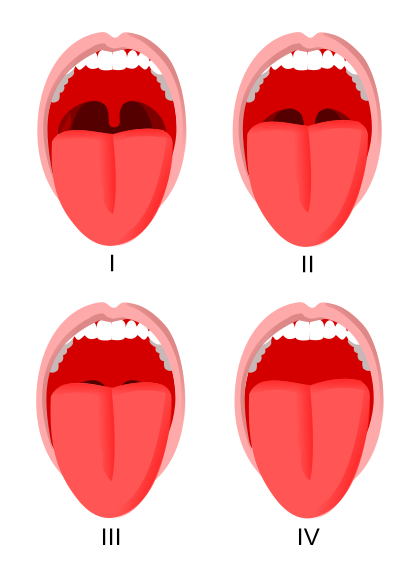
- Modified Mallampati class — visibility of the faucial pillars, soft palate and uvula (see the Scores tab for the original vs modified classes).
- Mouth opening / inter-incisor gap — space for the laryngoscope and device; normally >5 cm (≈3 fingers).
- Thyromental & sternomental distance — the size of the anterior mandibular space into which the tongue is displaced (neck fully extended).
- Hyomental distance and the 3-3-2 rule — 3 fingers mouth opening, 3 fingers hyoid-to-chin, 2 fingers thyroid-notch-to-floor-of-mouth.
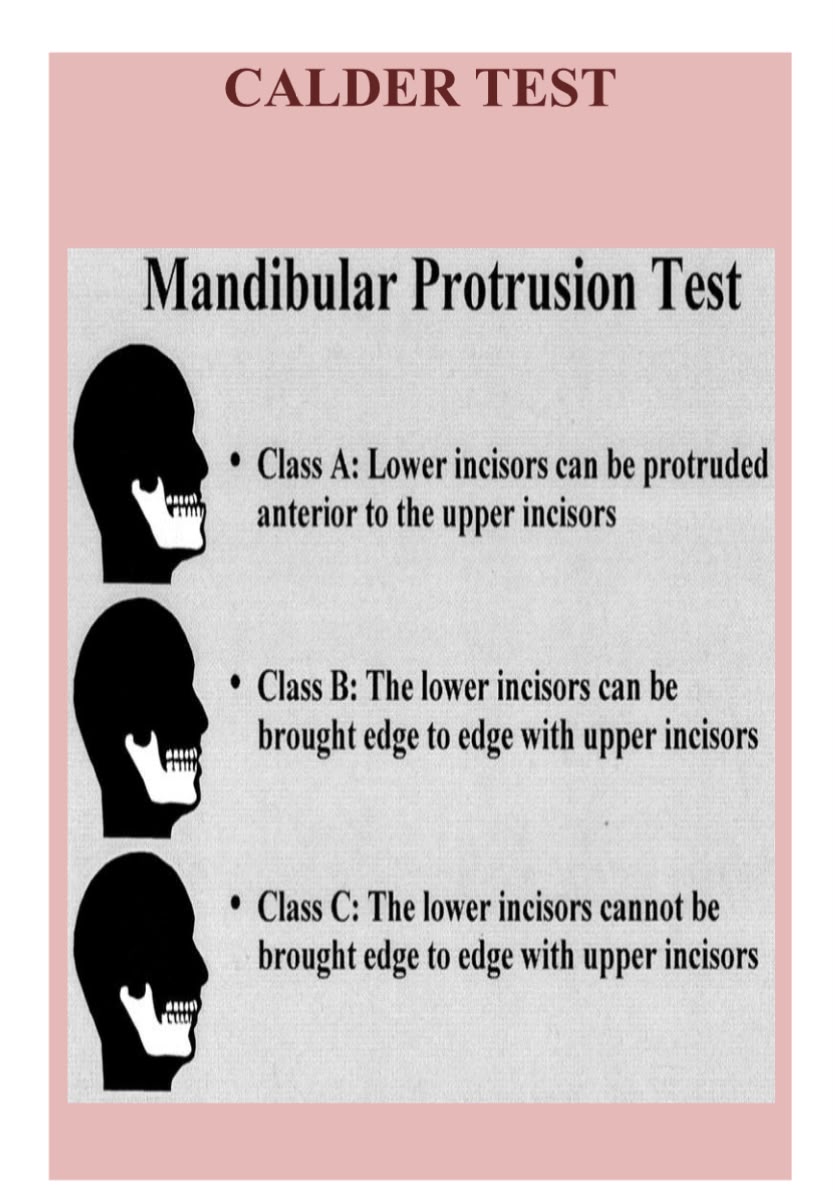
- Upper-lip-bite test (ULBT) & mandibular protrusion — how far the lower incisors can be advanced onto the upper lip; tests mandibular movement and dental architecture.
- Neck movement / atlanto-occipital extension — chin-to-chest then looking at the ceiling; the "sniffing" position depends on it.
- Dentition — prominent incisors ("buck teeth"), loose/capped/crowned teeth, edentulism (easy laryngoscopy but a difficult mask seal).
- Neck & soft tissue — short/thick neck, large circumference, goitre, mass, scar, radiation change, beard (mask seal).
- Ultrasound anterior-neck measures — increasingly used (see the Ultrasound tab).
Airway examination — the bedside tests illustrated
Original schematic diagrams of each manoeuvre — our own artwork, not AI-generated and free of third-party copyright. The remaining slots await real bedside photographs from our own patients (with consent).
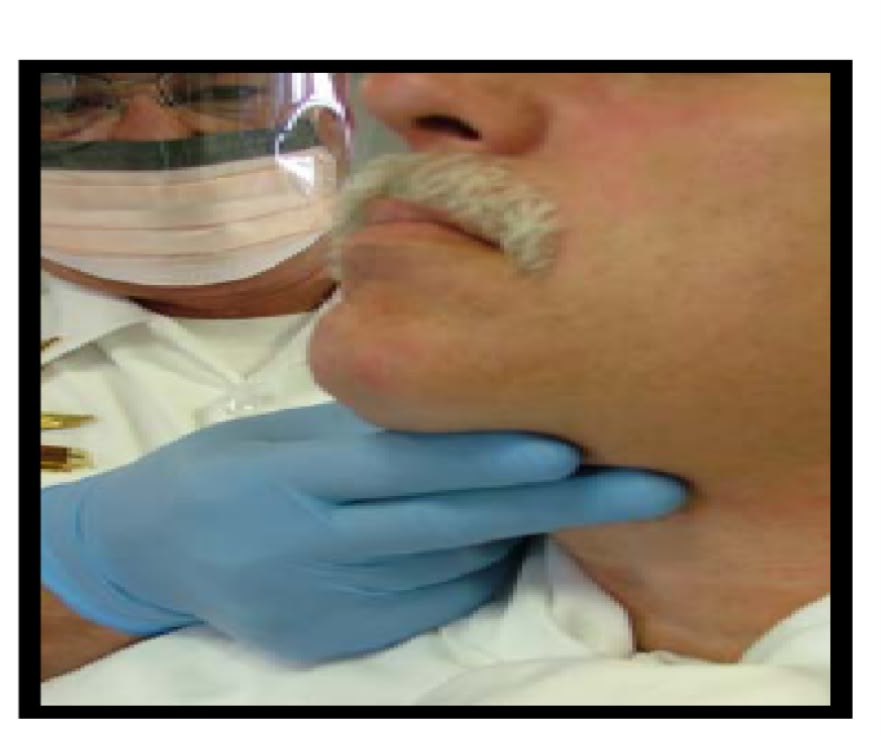
Maximal mouth opening measured between the incisors.
Sniffing position vs fixed/limited extension.
- LEMON (difficult intubation): Look externally · Evaluate 3-3-2 · Mallampati · Obstruction/Obesity · Neck mobility.
- MOANS (difficult mask): Mask seal/beard · Obesity/Obstruction · Age >55 · No teeth · Stiff lungs/Snoring.
- RODS (difficult SGA): Restricted mouth opening · Obstruction · Distorted anatomy · Stiff lungs.
- SHORT (difficult FONA): Surgery/Scar · Haematoma · Obesity · Radiation · Tumour.
- HEAVEN criteria describe difficulty in the emergency/critical-care setting.
Three minutes of tidal breathing (or 8 vital-capacity breaths) of 100% O₂ to an end-tidal O₂ >0.85–0.9 fills the FRC with oxygen and extends safe apnoea time. Nasal apnoeic oxygenation (15 L/min, or high-flow nasal oxygen) during laryngoscopy prolongs the window further — especially in obesity, pregnancy and critical illness.