What each measurement means, and the threshold that flags difficulty. Assess these at the bedside (see the Assessment tab).
Mallampati — original vs modified
Mallampati's original 1985 description had three classes; Samsoon & Young added a fourth in 1987, giving the modified Mallampati classification used today. Know both — the distinction is a classic viva question.
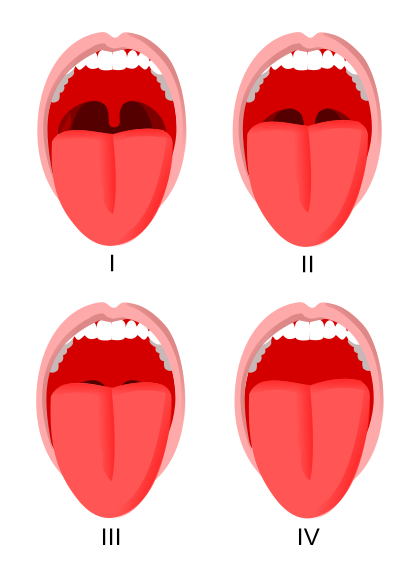
| Class | Original Mallampati 1985 (3 classes) | Modified — Samsoon & Young 1987 (4 classes) |
|---|---|---|
| I | Soft palate, fauces, uvula & pillars | Soft palate, fauces, uvula & pillars |
| II | Soft palate, fauces & uvula | Soft palate, fauces & uvula (tip may be masked) |
| III | Soft palate only (uvula base) | Soft palate & base of uvula only |
| IV | — not described — | Hard palate only (added class) |
Technique: patient sitting, mouth maximally open, tongue fully protruded, no phonation. Classes III–IV predict difficulty. Phonation or the supine position falsely improves the class.
Single bedside tests — thresholds
| Test | Grades / values | Predicts difficulty when… |
|---|---|---|
| Modified Mallampati | I → IV (above) | III–IV |
| Inter-incisor gap | Normal >5 cm / 3 fingers | <3 cm (difficult DL); <2 cm (difficult LMA) |
| Thyromental distance | >6.5 cm reassuring | 6–6.5 cm difficult but possible; <6 cm may be impossible |
| Sternomental distance | Sternal notch → chin, neck extended | <12.5 cm |
| Hyomental distance | Gr I >6 cm · II 4–6 cm · III <4 cm | Grade III (<4 cm) |
| Upper-lip-bite test | I: bite above vermilion · II: below · III: cannot reach | Class III |
| Mandibular protrusion (Prayer/ULBT) | A: lower teeth beyond upper · B: edge-to-edge · C: cannot | Class B / C |
| Neck / atlanto-occipital extension | Normal ≈35° | ≥⅓–⅔ reduction of extension |
Cormack–Lehane laryngoscopic grade — upgraded
The original 1984 grade (I–IV) has been refined by the Cook (2000) modification, which splits the ambiguous middle grades and groups the view by how you should act — easy → restricted → difficult.
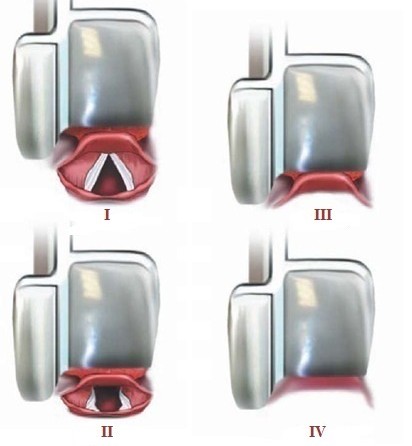
| Grade | Laryngoscopic view | Group / difficulty |
|---|---|---|
| 1 | Most of the glottis / full cords | Easy |
| 2a | Partial view of the cords | Easy |
| 2b | Arytenoids / posterior cords only | Restricted (intubation harder) |
| 3a | Epiglottis only — liftable | Difficult (bougie may succeed) |
| 3b | Epiglottis only — adherent to pharynx | Difficult |
| 4 | Neither epiglottis nor glottis | Very difficult |
- Grades 2b–4 define difficult laryngoscopy; 2b was carved out because it carries a much higher intubation-failure rate than 2a.
- POGO (Percentage Of Glottic Opening) — a 0–100% continuous score of how much of the glottis you see; better than C–L for videolaryngoscopy and for describing improvement with a manoeuvre.
- Always record the conditions: blade type/size, position, external laryngeal manipulation (BURP) and whether a bougie was used — a grade means little without them.
Composite / multivariable scores
| Score | What it combines | Cut-off for difficulty |
|---|---|---|
| Wilson risk score | Weight, head-&-neck movement, jaw movement, receding mandible, buck teeth (each 0–2) | Total ≥2 (of 10) predicts difficult intubation |
| El-Ganzouri / Simplified Airway Risk Index (SARI) | Mouth opening, thyromental distance, Mallampati, neck movement, jaw protrusion, weight, history of difficult intubation (0–12) | ≥4 suggests difficulty |
| LEMON score | 1 point each: Look, 3-3-2 abnormal, Mallampati ≥3, Obstruction, Neck immobility | Higher score → higher risk (used in the ED) |
| Arné score | Pathology, prior difficulty, symptoms, Mallampati, TMD, mouth opening, neck movement | ≥11 predicts difficulty |
Bottom line: composites improve on any single test but none is perfect — always prepare for the airway you did not predict.